Sunday, September 12, 2010

Down by the Sea

On the Guincho
Today was a planned break from frenetic touring. We got up when we felt like it, got a load of laundry going, and eased into things. Finally got out of the house around 11 and headed up the coast to the Guincho beach. There was a pretty good crowd there already, but we found a parking spot pretty close to the action.

Playing Rackets
What can I say? A beach is a beach. Not in a bad way, but people everywhere seem to use beaches for all the same things, and if you just look at the pictures, you'll see a random beach that could be anywhere in the world. There were people kiteboarding and surfing and playing ball and swimming and windsurfing and building sand castles and going for walks, and flirting with guys or girls, and families having picnics. Nothing surprising, aside from a couple of small biplanes doing aerobatics over the water.

Manny taught us a new game called rackets, which basically involves hitting a ball back and forth between two or more people, that appears to be popular here. We snacked on some juice boxes - they make them in large sizes here, not just the kiddie boxes - and had some custard pastries and some little snack-y chocolate things, mini-biscuits, and swam a bit and laid out on our beach towels. Perfect relaxation.

Palm Beach and Harbor
Manny had some errands to run in the afternoon, so he dropped us off at a beach right in Cascais, Palm Beach, while he did that. More of the same, less windy, more crowds, some topless sunbathers, a cantina nearby. Relaxed there for a couple of hours, wandering into the water when we got too warm, back out again to lay on the sand and bake. The water here is about comparable to the temperature in N. California or the Oregon Coast, I think. Not quite like the warm currents of the Pacific.

Came home and showered up, folded laundry, snacked on some cheese, olives, and nuts. Irene has bacalhau in the oven for dinner, and it smells delicious. Ciao!

Saturday, September 11, 2010

Lisbon, a little slower

We decided to slow down the frantic pace a bit for our second day in Lisbon. We stopped by the travel agent in Cascais in the morning and got our trip up north figured out, then went to the train station and took a short hop into Estoril, a lovely beach town nearby, to look for a music museum from the guides, and spent about an hour wandering up and down the avenues looking for it. Signage here can be, er, problematic. Gave up on the quest and went back to the train station to head into Lisbon.

Over here, public transportation is key to getting around the area. We're still having a tough time figuring out how it all works. In fact, we never did climb on a bus or metro, just the train and that one trolley. I could never quite determine which of the trains into Lisbon actually stopped at Belem, and couldn't find a brochure with a schedule on it anywhere, though there were "schedules" posted on big signs inside the station. Same thing applied to the buses, for me. Next trip to a major metropolis, I must find schedules beforehand.

In the Torre Belem
So, as a result, we hopped off the train at Alges, one stop before Belem. It was lunchtime for us at that point, so we found a nice little cafeteria downtown, reminiscent of one of the old Woolworths, and had lunch with a bunch of local shoppers and businessmen, away from the touristy area of the city. Michele had Salada com Gambas, shrimp salad, and I had Bifinas com Champignous, sliced roast pork with mushrooms and a light gravy, accompanied by rice, salad and fries. We had a little appetizer of (sp?) Queizo Frais, fresh cheese, a little like a cottage cheese in flavor but a sliceable consistency, and bread. We chatted with our waiter about the source of the french fries (London, not Idaho), and had a nice break.

Doc de Bom Successo
Just missed the trolley that went to Belem - actually we were arguing over whether it was the right trolley or not when it went by, Michele was right, I was wrong - so we set out to follow the trolly tracks on foot. Didn't take too long to get to Belem and we found a pedestrian bridge across the street to the Torre de Belem, one of the early fortifications which kept people from coming up the river Tagus to attack Lisbon. We climbed nearly to the top of the tower, and looked out at the scenery. If you're claustrophobic, the spiral staircases there are a nightmare, with people attempting to climb up and down at the same time in a space really meant for one.

Padrao de Descobrimentos
It's a pleasant walk along the shores of the river, through a park, past the marina to the next attraction, and plenty of little souvenir shops and eateries where you can grab a drink or snack. I am happy to report that there was only one boat on the boat ramp on a friday afternoon, though the husband shouting at his wife trying to back the trailer into the water was just like the scene at Lucky Peak back home. From a distance, the Padrao dos Descobrimentos doesn't look all that big, but as you slowly get closer, it assumes Rushmore-like qualities. The monument is designed in the shape of a caravello, a sailing boat, and is lined with the figures of royalty, explorers and other famed Portugese. There's an elevator ride to the top, but we weren't all that interested in waiting in line for it, for a slightly different perspective on the river views. We spoke a bit with an Iranian couple, who now live in Canada, and helped each other get photos taken.

Mosteiro across the Praca
There's a pedestrian underpass nearby, with street vendors and one particularly bad street saxophonist to get by, and we crossed the road to arrive at the Praca do Imperio, a very nice park with a large round central fountain, reflecting ponds with the obligatory horse statues, and lots and lots of park benches with shady spots to relax, check the guidebook, and regroup. Right next to the Praca is the Centro Cultural de Belem, where they hold concerts and recitals, and which also contains a museum of modern art, Museu Berardo. We went inside, where it was A) air conditioned, and B) had very clean nice bathrooms, and spent some time looking at and failing to comprehend pretty much the entire collection. I mean, it's obvious in some undefinable way that it is Art, but it's nothing I'd want to look at in my living room or office for any length of time, so who buys this stuff, anyway? There were a couple of pieces I found more whimsical by a South African artist, but the rest of it left me cold.

Manny had been helping his friend, Ricardo, deliver some cases of wine for his mother's business, early in the day, but he drove into town to join us at this point, and we went into the Mosteiro dos Jeronimos, which is a 16th century monastery, containing the National Museum of Archeology, for a brief look at the church. The place was crowded with bus after bus of tourists, and we decided we wanted to see the more modern side of Lisbon, instead of taking the full tour of the museum. Manny drove us all out to the area where the 1998 World's Fair was held, and we had a nice time at the Oceanario, looking at the marine life, including one pacific otter who is a long long way from home. We promised to say hello to his Northwest cousins when we get back. There was a great display about amphibians, with a ton of exotic frogs. I do love little froggies.

Interior shots never turn out this well
This entire area was an old deteriorating portion of the city before the Fair, but it is a wonderful example of modernity now. One of my favorites was the volcano shaped fountains that burble along merrily for about twenty minutes, then suddenly "erupt", spraying water far into the air. Couldn't catch an eruption on camera as we were driving through, unfortunately. After exploring the area by car, we headed back up the coast to Cascais, stopped at the grocery store to pick up some cheeses, sausage, olives - there are dozens of varieties to chose from here - then to a local chicken roastery - think KFC in popularity, and with a walk-through pickup window - for a couple of whole roast chickens, one buttered, the other spicy, and back to the house to gather with Manuel and Irene and Robert for a late dinner and loads of good conversation after out on the patio, with the cool ocean breeze blowing. I leave you with a peaceful image from the church of the Jeronimos.

Friday, September 10, 2010

Rick Steves' Portugal by Rick Steves

Rick Steves' Portugal
My wife and I love Rick Steves' travel shows. If we happen to be surfing the tube and catch him on PBS, we stop to watch his adventures. So, when I first started thinking about a European adventure, I rushed to the library and grabbed all the stuff by him that they had.

Like all of his travel books, this is packed with information, but not a monstrous tome that you'll wear out your arms carrying it on the trip. Also, like the rest of them, Rick Steves' Portugal has about twenty pages of introductory information that's just generally good advice for travel in any country, with the specific country information pasted in, and some very country-specific practical information in the appendix at the end of the book. The appendix contains a short history of Portugal, information on telephones, email and mail, transportation, holidays and festivals, and a short list of "survival phrases" in Portuguese.

The bulk of the book is broken into sections by area, with instructions about the best way to travel to the location, the main neighborhoods and attractions, great places to stay and to dine, and background information about the area and its sights and activities.

One of the things I really like is the way Steves' whittles down the information on, for example, lodgings in each city to three to a half dozen options, ranked by expense. Most of the places he lists are not going to be found on Orbitz or Travelocity's hotel searches, and he provides contact and reservation information for all of them. He also provides an itinerary for a walking tour in each city, as well as listing various motorized tour options and even private guides for hire.

For the moment, I'm giving this book an excellent rating, but I'll know for sure when I'm done jaunting around Portugal in a few weeks, and I'll update this post then.

Lisbon, on the Run

We went into downtown Cascais first thing in the morning and chatted with a travel agent, Susana, for a while about putting together a trip to Oporto for us for next week, then went over to the Tourismo office and picked up two Lisboa Cards, which serve as passes for the trains, buses, trams and metro, and give free admission or discounts into many attractions. We walked to the train station, hopped on the train to Lisbon, and relaxed to enjoy the ride for about a half hour. The station at the end of the line is about a kilometer short of the Praca do Comericio, which sits at the foot of the Baixa district, and is known by Manny as "the place with the guy on the horse". We hoofed it, ourselves, to the Placa.

From there, we walked several blocks to the place where trolley #28 stops, and jumped aboard, using our passes. While this is a very quaint and amusing way to travel, in the trolley we were packed tighter than sardines (a local delicacy) in a can, and we jumped off after a short distance at the Miradou de Santa Luzia, a great viewpoint from which to catch sight of Lisbon for the first time, never to board public transport again, aside from the train ride home. By this time, it was nearly noon, so on our way afoot up hill, we stopped at a little sidewalk restaurant - there are hundreds of small places, everywhere - called Comidas de Santiago, and Michele had bacalhau a bras, a traditional cod dish with rice, and I had dourada na grelhe com batatinhas em casca, grilled bream with potatos and vegetables. All extremely delicious, and we cleaned our plates completely.

Proceeding further, and still on our tour plan, up the hill to the Castle of Saint Jorge, where we bought discounted tickets, and got to browse the museum of pottery shards - not its real name, but that's about the extent of the collection. The site has been occupied by people for thousands of years, and everything from bone needles to terra cotta roof tiles were left behind. The castle, itself, has been restored over the years, and its walls are great to climb on, and a great photo opportunity, with more lovely views of the city. Be sure to check out the medieval sound systems while you are there, they're still used for concerts today.

At this point, our carefully laid plan began to fall apart, as we decided to head directly for the Convento do Carmo, rather than following the tram line back down the hill, and we didn't see the area where the free buses were shuttling folks back to the square. Our maps didn't contain any of the warren of narrow streets that we encountered, and we navigated by sun and stars until we finally came to a place called Martim Moniz that was listed on the map. It was hot, sweaty work and Michele and I were both growing a bit cranky by the time we got ourselves oriented and on the way to our next landmark, the Rossi, which contains a major train station. I was walking east at one point when I realized I wasn't quite sure that was taking us where we wanted to go after leaving Rossi  (I still got confused, just writing about it), so I did an about face, and was fortunate enough to spot the Elevador de Santa Justa, one of the ways up the hill to the convent.

Our passes gave us a discounted entry to the Convento do Carmo and Archeological museum there, and it turned out to be cooler inside, complete with a WC, which made it all worthwhile, above and beyond the interesting artifacts there. Public restrooms are a little sparse and difficult to find in the city, so you find yourself going into a small cafe and buying something to eat or drink, in order to use the facilities. The convent was partly destroyed in 1755 in a massive earthquake here, and never rebuilt. We spent a half hour or so here, relaxing and enjoying the museum, sitting on the steps and having a drink of water.

After leaving the convent, and stopping at one more church nearby, we decided that was about enough of museums for a while, so we broke off the original plan and began to alternate guide books for ideas on where we wanted to go next. We went to the Miradou Sao Pedro de Alcontar, another nice park where you can relax on a bench with a cool drink and look out over the east side of the city, then on up the road to the Praca Principe Real, a gorgeous park filled with trees and with some truly amazing fig trees, reminiscent of one from my childhood in Santa Barbara that's hundreds of years old. There's a "water museum" listed in the guide book that we decided to go see. Big ripoff. Just a stone water tank, no displays, no tours, no discount with our card. Onward to the Jardim Botanical, where we wandered for a while among the trees and plants in the shade. A great place to wind down, and you could probably spend hours there. Unfortunately, it isn't free with the Lisboa card, and the butterfly exhibit had closed at 5, so we weren't able to enjoy all it had to offer. I was waiting on a bench for a while in the spot pictured above for Ranger Murray to come give a nature talk, but I guess he must have been busy.

Enough of Lisbon for one day on our plate, though we took a number of photos of more statues along the way downhill, we headed back to the train station, went back to Cascais, and had a fantastic meal of seafood stew for two at a restaurant called Checkers. Full and happy, we went back home, and eventually, to bed.

Thursday, September 9, 2010

Fall of Hyperion by Dan Simmons

The Fall of Hyperion
In Fall of Hyperion, Dan Simmons fulfills the promise of a stunning conclusion to the Hyperion Cantos. This would be great if 'twere true, but I'm afraid that the sequel to Hyperion is a bet of a let down. In mitigation, Hyperion was so good that only sheer genius and the writing strategy of a grand master could have better it & sadly, Fall didn't quite make it.


Simmons gets away from the travelers' tale motif he used so well in Hyperion, and tries to keep track of multiple characters and storylines through the POV of a cybrid reconstruction of the cybrid reconstruction Brawne Lamia meets and loves in Hyperion, who now goes by the name of Joseph Severn. He is able, through his predecessors's computer shunt link with Lamia, to eavesdrop on the thoughts of the surviving pilgrims.

There were several things that I feel kept this novel from working for me:

First, I'm not fond of multiple POVs in a story. They make it difficult for a reader to follow the action, and they often compromise the integrity of characters' identities. In Hyperion, there was a reasonable justification for using them, but in Fall, it just confusing things.

Second, Simmons overused the resurrection thing. He keeps setting up pseudo cliffhangers where the characters are apparently killed, then when we come back to their POV we find that they are actually still alive. The only character in this novel who should have had any reason to be resurrected was Father Hoyt/Dure, who is infested with the symbiotic cruciform. The only character that he doesn't resurrect from apparent death is Sol Weintraub.

Third, the whole thing ends up being solved with a major deus ex machina ploy.
*SPOILER WARNING*

Colonel Kassad's mysterious Moneta turns out to be Sol Weintraub's daughter Rachel, who has doubled back from som fantastic future time to save the day. If she had the power to stop the Shrike all along, why didn't she? It would have made for a short sequel, eh?

There's a lot of verbiage devoted to the death by consumption of Joseph Severn on primitive historic Earth that ultimately turns out to have nothing substantive to do with solving the problem of the Shrike and the impending war. There's also a bunch of metaphysical mumbo jumbo about the Shrike being one aspect in the Trinity of a machine god that ends up being a false lead, too.

There are some unsolved miracles and other loose ends and war between the humans and the Ousters is narrowly averted when everything bad turns out to have been the result of the plotting of one faction of the AIs.

There were some good moments, such as the time when the Consul (whose soul has been racked with torment for years over his double betrayal of both the humans and the ousters) learns that his double agent antics were not only known to both sides, but counted on by his controllers.

There were some things I was counting on learning more about in this novel, such as the treeships and the pilgrimages sponsored by the Church of the Shrike, that Simmons never does reveal. Indeed, he seems to be laughing up his sleeve at the readers in the end when his surviving characters skip off into the sunset singing, "Somewhere Over the Rainbow" (from a movie in which Dorothy wakes up to find it was all just a dream).

Overall, if one has read Hyperion, then you must read this to find out what happens to everyone, but it just doesn't live up to the previews, you know? I doubt I'll read Endymion.

Strolling in Sintra

Didn't try to get too early of a start yesterday morning, actually even slept in a bit, especially for me. Around 10:30 am Manny drove us into Cascais downtown and we had a bit of breakfast in a little cafe in the Jumbo store. The lady at the counter there was from Angola, and spoke very good English, gave us a full rundown on the menu and the operation of the lunch counter. Amazing thing was the prices. I had a presunto and cheese croissant and a double espresso, and Michele had a croissant with strawberry jam and a single espresso, and it was only 5 euros, 60! I think I'd have paid that much just for the drinks at Starbucks.

Went by a travel agent in the downtown area, Jorge, and talked with him about getting in a trip to Spain for a few days next week, but all of their packaged tours had the wrong departure dates. We talked with him for quite a bit, and came away with some suggestions of side trips wrapped around a core trip to Porto, up in the north part of Portugal. We spent a couple of hours strolling through the shops down by the beach, bought a beach towel, had some gelatos at Santini's, which is evidently frequented by the rich and famous. I thought I bumped into Angelina Jolie in the WC. Went by the toursimo office and gathered some information from them, bought a Portugal map, after they were done with their lunch break at 2:30. There was a flea market in progress, and I just couldn't resist the book table.

We stopped by the house to pick up Manny's younger brother, Roberto, as he needed to do some back to school shopping. Students here, in all grades, are responsible for buying all their textbooks and supplies, just like college students in the U.S., and the department stores actually sell textbooks. Manny drove Michele and I up to the historic area of Sintra, about 15km away, and dropped us off there, with Irene's cell so that we could call him when we were ready to come home. A role reversal from four years ago, when he lived with us, eh?

We visited the Ferreira da Castro Museum. da Castro was an author, contemporary with Hemingway, nature lover and ecologist. The front desk lady gave us a pamphlet about the museum longer than most doctoral dissertations, in English. He traveled widely, and turned to writing travel and adventure books after his early works were censored for political reasons, I believe. We sampled some ginginja, a legendary local cherry liqueur or maybe brandy, in little chocolate cups - delicious!

Sintra is filled with small shops, most of which cater to the well-off tourist crowd. There were some lovely things for sale, but a 250 euro handbag is just a little bit out of our league, so we enjoyed the hunt of shopping, rather than the kill, so to speak. Down by the park, handicraft artists lay out their wares on a little guard rail near the embankment, and Michele did find a couple of pretty necklaces that were only two for 6 euros, so she made her first purchase in a foreign currency. There's a series of abstract sculptures in the park area there that I really didn't quite get, except for a highly functional one I rather liked.

We discovered the Museum of Pedro Anjas Teixera, a very talented sculptor, not in the least abstract, where we spent about 45 minutes, and covered things very thoroughly. Sorry I can't oblige you all with the obligatory nude European statuary, though those works were quite good, but I took more photos of his other stuff, such as the praying mantis battle at left, and The Good Gardener Frog, which I'll have to send to my mother, avid collector of frog statuary that she is - the picture, not the actual statue.

We were going to have a light meal of appetizers in the local crepery, but when we sat down and looked at the menu, the prices were completely ridiculous, and the waiter, like all French waiters everywhere are required to do, ignored us long enough that we made up our minds to go elsewhere for our simple peasant fare. Found a little place called the Village Cafe tucked away by the church and had some cheese, olives and chorizo that was just mind-numbingly tasty and  couple of beverages for about 11 euros instead, while watching CNN on the big screen. Lot of terrible things going on in the world, but we're on holiday from all that, don't you know.

Called Manny a little bit later to come pick us up. Wandered over to the palace in town. We'd been by it earlier and thought about taking the tour, but it was closing in 30 minutes so we felt we just couldn't do it justice and skipped it. Heard a conversation in English between a couple going the same direction, and had a nice little chat with some Canadians from Vancouver on holiday. Michele took a picture of them and their toddler. Can't imagine traveling with small children, Michele has a tough time just keeping me out of trouble.

Came on home to a baked salmon and rice meal that Manny himself had prepared for us and his parents. Sat down with him by the computer after dinner to nail down the itinerary for the rest of the time we're here. My free-wheeling ways properly curtailed, I doddered on off to bed.

Wednesday, September 8, 2010

The Fuller Memorandum by Charles Stross

The Fuller Memorandum (A Laundry Files Novel)
The name is Howard...Bob Howard. The United Kingdom's secret agent in Stross' latest novel doesn't even pack a pistol, much less have a license to kill. He's married, and likes to lay in on Saturday mornings enjoying a leisurely breakfast. He works for The Laundry, a super-secret agency responsible for tracking and combating paranormal manifestations before they get out of hand. Most  of the time he's just a paper-pusher, but every once in a while he gets up to a bit of mischief, as he does in The Fuller Memorandum.

Stross is just so deliciously snarky in this book! Towards the end, as things get intense and our hero finds himself in the clutches of some really nasty cultists, the sarcastic wit disappears, but it's pretty tough to keep a sneering upper lip when they're carving sushi from your body.

One of the best examples of Stross' British humor comes when Bob goes to replace his smartphone.
"About the only smartphone that doesn't stink like goose shit is the JesusPhone. But I've steadfastly refused to join the cult of Jobs....The JesusPhone, I swear it is smiling at me: Come to me, come to me and be saved...That's at least a class five glamour."
and
"Mo (Bob's wife) rolls her eyes. 'Bob loses saving throw vs. shiny with a penalty of -5. Bob takes 2d8 damage to the credit card.'"

This isn't exactly urban fantasy, but something similar. Stross borrows heavily from Lovecraft's mythology, as well as other dark tales. It appears that we humans are living in a universe far stranger than we think, and the beings that inhabit that universe are either indifferent to us, or find our souls to be tasty snacks. The end of the world is nearer than we think, as the combined thoughtwaves of humans on the planet is rapidly approaching critical mass, and are about to draw the attention of very bad things.

People who know about the coming apocalypse either are working for The Laundry or one of its foreign counterparts to try to delay the inevitable, or they have decided to throw in their lot with the elder gods and demons, to try to negotiate a favored position when the time comes. Bob runs afoul of one such group, and has the devil's own time getting free.

You really should read this one, and the previous books in the series, The Atrocity Archive and The Jennifer Morgue.

Have fun in a storm in the castle

We got ourselves together in the morning and left Manny's apartment, then stopped at a little cafe and had a very milk-y espresso and some tasty flaky pastries for breakfast there. Fueled up, bought some water bottles and headed north and westwards, intending to do a little sightseeing on the way to Coimbra. The best laid plans, you know...

Somewhere in the countryside, when a "Monumento" sign appeared, Manny said he had no idea what it was, but that it meant that there was something interesting and historical that direction, did we want to check it out. Being the bold and intrepid sorts, we of course said "yes", and we were thereby able to encounter our very first Roman ruins, Quinta de Fornea. The signs were all in Portuguese, but we had Manny to translate, and got to enjoy wandering through them.

Heading further north from there, we saw another "Monumento" and pulled off the road at the little city of Belmonte, where we found our way to the tourist information booth after a bit, and got a nice orientation on the local sites from a worker who spoke English quite well. The town had a castle, several old chapels, and an old Jewish quarter, synagogue and museum.

We started with the castle, which turned out to have its interior courtyard full remade into an ampitheatre for musical or stage productions. We were still able to clamber around on its walls and take some pictures of the views from there, though the weather had gotten a bit cold and nasty, and began to drip rain on us. There were other tourists coming and going at a fairly steady pace, when a women came in and shouted at all of us that the castle was closing for lunch, and we'd need to leave. Manny engaged her in conversation, and we found out that all of the attractions there would be closed for the next hour and a half, so we never got to see the Jewish quarter.

Heading further north, we saw another sign...you can see how the day is going. At this town, we pulled off to look at some more Roman ruins, Torre Centum Cellas, this time containing a tower that may have dated from Roman times, as well, but there were no placards posted with anything about the site, so we just had to guess. The north central portion of the country is "heavily" forested, and reminded us a great deal of some portions of Idaho. The scent of the pine trees made us feel right at home as we drove, turning west to make a "brief" stop in Viseu. Manny phoned a friend of his from college whose home is there to ask her about the local attractions, and she told him that there were "some churches" we might find interesting near the center of town. While he was talking to her, I took a photo of a very interesting pizza place (left), which unfortunately is no longer in operation, so we weren't able to go inside.

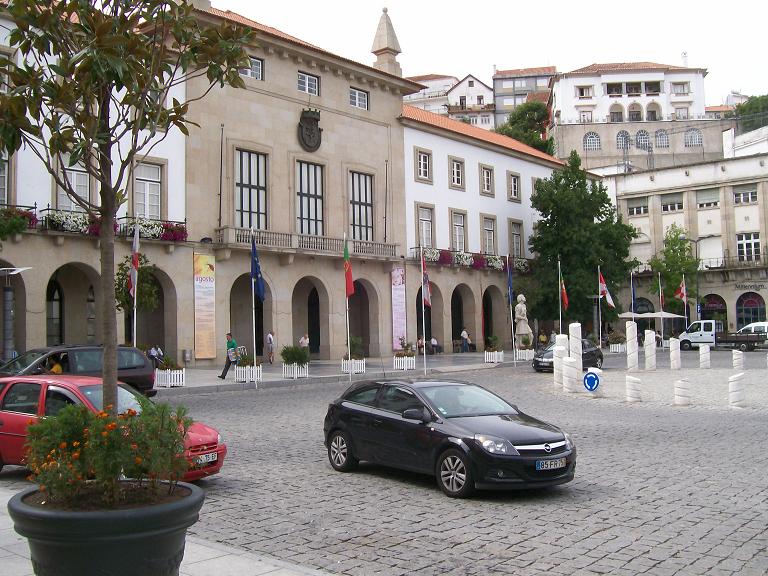
We found a parking spot near a historical-looking convent, and headed for one of the local cafes  for a quick pick-me-up espresso before exploring. The espresso, by the way, was twice as good as Starbucks' and only cost .60 euro or 78 cents! We followed the signs to find the local tourist information office, where we found a very chatty Portuguese girl, (for a mental image think Joan Jett) who has lived off and on in New York for the last twenty years, and who told us what route to walk to see the really important stuff, and a map of the downtown area.

Most guidebooks will mention these tourist information offices and suggest you stop by them for help. However, they're listed in the books as TIs, and the signs that point to them say "Tourismo i", and are very difficult to follow, as they assume that when you're within a couple of blocks of the office, you'll be ok. Great sources of information, usually with English/French/German/Italian speaking employees, but in my small bit of experience so far, tough to find. The one at the castle was listed on the large site map, but had been moved sometime after the sign was created, and the one in Viseu suddenly was across the street and down the block without any signs about the change in directions. Worth the hunt, though.
We stopped at an art museum, Museu Almeida Moreira, which displayed some lovely pieces of (mostly) Portuguese artwork from the collection of Moreira, who was a wealthy military man and art collector, curator of the Grao Vasco museum at the Se, which we visited next, and died without children, so he left his collection to the people. I understand there are many many artworks stored there, but the funding so far has only allowed them to display a small sample. My favorite painting was one of a ship on the high seas by Luis Ascencio Tomazini. I gotta remember to google him later.

Unbeknownst to any of us, Viseu was once the heart of Catholicism in Portugal, and the Holy Se, residence of high church officials. The Misericordia church and museum, pictured above, were closed for renovations, but the Cathedral and its museum were not. We sort of poked around one old portion of the cathedral for a while, taking some pictures, then wandered over the the cathedral proper, where we were totally blown away. It didn't look like much from the outside, but the splendour inside was absolutely crazy. I was muttering to myself, variations on "Holy Moley" the entire time we were there.

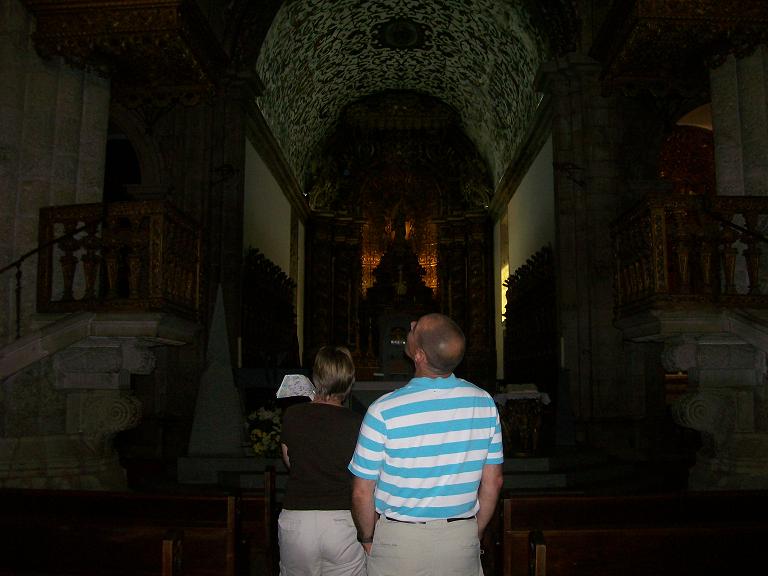
The cathedral began construction in 1092, finishing early in the 12th century, and is still in operation today. There were plenty of black clad blue-haired old ladies coming and going, spending time there in prayer, as we and others toured. Immense vaulted ceilings, with massive knotted ropes carved in stone. Gold leaf covered ornate altars and shrines to the Virgin Mary. You know the drill, but you never really "get it" in your gut until you stand in the middle of one of these places, and everywhere you turn your eyes, there's some new piece of holy artwork. The lighting inside made it very difficult to get good pictures, unfortunately, so I ended up buying a postcard from a souvenir store a bit later.

At the front of the cathedral, near the altar, there was an unadvertised doorway with stairs leading upstairs, and I could see an attended counter at the top, so we headed that way. This turned out to be the entrance to Tesouro Meseu da Catedral de Viseu, and for a 2.50 euro fee we were given brochures and the chance to view the holy relics there. Again, words do not properly express the time, detail and expense that must have been spent on creating these expressions and trappings of worship. There were many statues of saints, including several, such as Loyola and Augustine, that I recognized.

There was an amazing carving of the nativity scene (18th century?) perhaps four by four feet, with far more attendants at the Christ child's birth than I remember being in the story, including a man from the tropics in a plaited skirt and an elephant, as well as some folks in tophats and suits. Illustrated manuscripts, a gynormous hymnal of Gregorian chat from which Michele was able to hum the tune, priestly vestments embroidered in gold, massive golden rings and jeweled crucifixes, ivory carvings from the time of the Portugese explorers.

Around 5:30 in the afternoon, we made the decision to skip Coimbra, as we'd arrive there very close to dark the way things were going. There was a big fair going on on the far end of town, which was supposed to have plenty of booths filled with local handicrafts, so we set off to find the Pavalho MultiUso. The local handicrafts, however, were limited to some glazed terra cotta pottery and embroidered linens, mostly, and the fair was filled with the usual junk that we'd not be surprised to see at the Western Idaho State Fair - a much shorter journey. We did have a nice simple meal of traditional bifanas, pulled pork meat with a light sauce, wrapped in buns with a crispy crust, before getting on the road and heading more or less directly back south to Cascais, a three hour drive.

When we got home, we got to meet and talk with Lucy, Manny's older sister. A very nice young lady, who studied music, she and Holly would get along quite well. Off to bed way too late for this old man, and I actually ended up sleeping in till after 8 this morning.

Tuesday, September 7, 2010

Blood from Stones:The Secret Financial Network of Terror by Douglas Farah

Blood From Stones: The Secret Financial Network of Terror
This one is definitely a scary read. Douglas Farah is a journalist who has followed the story of terrorist financing, encompassing groups such as Hezbollah and al Qaeda, around the globe. The title, besides being a take on an old proverb, refers to the conflict diamonds of the African continent. He first began to pick up the trail of terrorist involvement in the trade of diamonds mined in Liberia and Sierra Leone, when he was investigating the financing of rebel forces there. Buying diamonds from dictators such as Taylor in Liberia and RUF commanders gave al Qaeda a foolproof way to conceal their cash from intelligence agencies investigating banking records trying to shut down terrorist cells.


Farah also describes the hallawa system, in wide use in the Muslim world, which uses a network of friends or family to make funds available across individual boundaries based on trust, or "hallawa." The way it works is, for example, a Pakistani working in the UAE who wants to send cash home to his family, without paying the taxes imposed at the border, visits a hallawa broker in the UAE. He gives his money to the broker, who then calls a nephew, perhaps, in Pakistan, who is also a hallawa broker, and tells him to make the money available to the original man's family. No cash actually changes hands between the brokers, who have their own internal accounting system, opaque to the usual investigative tactics of law enforcement or intelligence agencies.

He also gets into the world of gold smuggling, which centers, in the Arab world, in the UAE, especially Dubai. While gold may be heavy, it's much less bulky than carrying an equivalent amount of cash across borders. Gold also has no serial numbers and isn't subject to inflation or devaluation in the way that many currencies can be.

Finally, Farah devotes some time to the whole area of Muslim charities, many of which are involved in funneling large amounts of cash to terrorist groups in Palestine, Chechnya, and other hot spots. These charities have been allowed to operate freely in the United States for many years, and only after 9/11 was there any sort of crackdown on their activities. In this section, Farah spends a lot of time criticizing the US intelligence community for its "willful" blindness in many of these areas. He and other journalist had evidently attempted for years to bring these matters to the attention of the FBI and CIA, but they just weren't interested.

Anyway, take away from it what you will, this is a great primer on terrorist financing, conflict diamonds, arms smuggling, and a few other subjects.

Covilha

Monday morning, we threw Rick Steves under the bus. The place we traveled to was not in his guidebook. We got up and ate a light meal of pastries and delicious cafe con lait. The miniature custard cups called pastel de nata were particularly good. Manny drove us to the bank, and I successfully used the Multibanco to get some euros for spending money. The final tally may not have arrived in my statement, but this appears to be the best way to get currency "exchanged", without fees or markups of any sort.
We drove north through the center of Portugal to Covilha, a small town which used to be a manufacturing center, but which is now mostly supported by the university here. After we got clear of the Lisbon metro area, the countryside turned mostly agricultural, with grape vines, corn fields and olive trees, and some very prosaic nuclear power plants. It was a warm summer day, and a very uneventful drive, aside from some very persistent gypsies at a petrol station who wanted to sell Manny an Iphone for a mere fifty euros. I am happy to report that service station facilities in Portugal are quite clean, though the hand soap needed to be refilled.

Upon arriving in Covilha, we first went to Manny's apartment, which he shares with several other students, and dropped off our rather minimal luggage. Then we went out for lunch at a great little restaurant next to the university, where we ordered a variety of Francesinhas, an open-faced triple-decker sandwich filled with various meats, topped with cheese and a sliced egg, and smothered in a spicy but simple sauce. I can't remember what mine was called, but it loosely translated as "I am Full", and had linguica, frankfurters, ham, and pork inside. It came with a side of fries that, unfortunately, had to remain untouched.

Manny needed to spend some time in line at the registrar's office, so he took us up to the old center of town and dropped us off, leaving us his cell phone so we could keep in touch.Michele and I spent several hours wandering through the maze of streets surrounding the town square and its city hall. There was a kiosk in the southwest corner of the square which sold cafe and juices, mostly, where the locals relaxed and the teenagers were skateboarding. This is probably the largest level area in town, which is built on hillside. Any direction you walk from here is at an incline, ranging from the mildly hilly to completely exhausting.

We poked our heads into many of the small local shops. My first actual purchase in a foreign currency was a small pocket knife, since I hadn't felt properly dressed since I had to leave mine behind to get on the plane back home. It ain't Toledo steel, but it will suffice to cut fruit, open packages, and sharpen pencils as needed. In general, prices were clearly marked in all of the stores we saw, and a smile and thank you were all the Portuguese we needed to make our purchases.

The town is a curious mix of old...and really old. There's a wonderful little park, Jardim de Publicos, on the northwest side, with some spectacular views and plenty of places to relax on a bench and enjoy a gelato. Near the park is a memorial to the veterans of WWI, which provided a great photo op.

Located about 300 km away from the more touristy areas of Portugal near Lisbon, not many of the locals spoke much English, though the younger store clerks and barristas gave it their best try. I did manage to gather from one saleslady's pitch before she realized that we didn't speak much Portuguese that they were having a 30% off sale on everything in the store, but I just couldn't see a need for yarn, so I was unable to boost the local economy for her.

There is a magnificent church right on the town square, which was covered up and undergoing major renovations, so we weren't able to see it, but the postcards of it were very impressive. Towards the end of our perambulations, Michele and I wandered uphill  past the town's rather gothic cemetary and found the Capela da Santa Cruz, which was built in the 1640s, and which is still in use today, apparently for weddings and other gatherings, mostly. Not gaudy or ostentatious in the slightest.

It took Manny quite some time to get through the registration lines, but around 1900 hours he called and said he was mostly done, and would meet us back at the town square in twenty minutes. We got a bit confused coming down the hill from the Capela, and after some twists and turns, ended up about a half block away from the university building just in time to see Manny, himself, walking along the street on his way to pay his tuition. One rather frustrating issue with the langauge presented itself when Manny's landlord, understandably anxious about when he was to get his rent, called on the cell phone I was carrying, and couldn't understand why an American was answering. He had no English at all, and I'm afraid his wife, to whom he passed the phone, probably will remain confused to the end of his days. We shook his hand and were introduced when he stopped by later to tell Manny about the improvements he had made to the place over the summer break, so at least he left with a face to go with the clueless voice.

We got our first taste of a big shopping center in a more level area of town when we went to pick up some salad ingredients for dinner back at the apartment, and sandwich fixings for our drive onward today. The Continente was a typical superstore, with a color scheme highly reminiscent of Target and a crowd of shoppers busily buying back to school supplies for their kids and grandkids. When we were entering the shopping mall, Manny stopped by the entrance to greet some former coworkers from his job at an appliance store there, and I was standing to the side, observing their European cheek kisses and managed to get smacked in the rear by the automatic door. The poor fellow who triggered the door apologized profusely, but both of our wives laughed at our embarassment unreservedly. When we got back to the apartment, Michele couldn't resist putting the Mom's touch to work on the place, and soon had the kitchen cleaned and organized.

Spent most of the evening sitting around the kitchen table chatting with Manny about his experiences in America and the friends he left behind there, and didn't get to bed until quite early this morning, which meant I could at least see that the Broncos were leading Va Tech by 10 in the first quarter on ESPN's web site, allowing me to sleep peacefully at last.

Monday, September 6, 2010

One Jump Ahead by Mark L. Van Name

One Jump Ahead (Jon & Lobo Series)
One Jump Ahead appears to be the first book in a series about Jon & Lobo, and I'm definitely looking forward to reading the next two or three that my library stocks. This has got that out of the frying pan and into the black hole quality that I really enjoy for quick mindless entertainment. The hero, Jon, is an engineered human being, with nanomachines living within his body which he is able to communicate with, and have them do things for him by creating swarms of nano-bots outside of his body.

The planet where he was created, Aggro, has been blockaded by the interstellar authorities, and everyone believes that all of the experimental humans like him have been destroyed. I think there's probably a back story here that Van Name may have published in short story form, and I may have to do some research in that area.

Jon uses his nanomachines to help him rescue the kidnapped daughter of a corporate executive by having them create swarms and "eat" all the weapons that the abductors are holding. Ok, there's a bit of the willing suspension of disbelief required to think that a bunch of nano-sized organisms could consume that volume of metal nearly instantanteously, but once you get that out of the way, everything else that follows is logical.

As part of his reward for thwarting the kidnappers, Jon gets title to a decommissioned military space craft, called Lobo (is this some sort of backhanded tribute to Laumer's Bolo series?). Lobo is run by an AI who is just a little cranky and quirky and makes plenty of sarcastic comments, but who, after Jon has him refurbished, can deal out the death and destruction quite handily.

Rescuing the girl, getting Lobo, and getting off planet are about the last things that go smoothly for Jon, and he muddles from one mishap to the next for the rest of the book. Some fun action, decent dialog, and a semi-twisty plot make this one worth a read.

Sunday, September 5, 2010

First Impressions

As I mentioned earlier, I'm hijacking this blog to report on my impressions from our travel in Portugal. Book review posts will continue as scheduled, this is just something a little extra.
We arrived at the Lisbon airport around 8 am, very fatigued and jet-lagged, and after following the crowd through the long long terminal to where we needed to present our passports to gain entry into the country, found ourselves in a Disneyland style loopback queue for a little over an hour, inching slowing forward. My wife, M, struck up a conversation with a lady from Brazil in the line behind us, and though they had very little language in common, just a smattering of English and Spanish (Brazilians speak Portuguese), they managed to share photos of their children, and discuss the daughter of a fellow Brazilian in the group who is a doctor in Canada now.

The very polite passport officials finally stamped our passports without question or comment, and we were now free to move about the country. We continued following arrows and signs saying "Salida" until we found ourselves in the public area, where our Portuguese son, Manny, saw us and ran to greet us. We had been a little worried that he might give up on us, as the passport delay had put us a bit behind on our arrival time, but he perservered. Ok, so my major first (not discouraged so far) impression of Portugal is that the drivers here are insane, and their auto traffic is utter chaos. There seem to be few rules, unless the police are handy, except to get wherever you're going in the quickest, shortest possible way.

Manny drove us east from Lisbon to Cascais, and on a short sightseeing trip up the coast through a beach area called the Guincha, very popular with surfers, kite boarders and both locals and tourist, up to a place called Cabo da Roca. As fate would have it, we arrived in the middle of a rather large motorcycle rally, and very nearly got Manny's car boxed in in the parking lot. I was surprised to see the distribution of bike types; I had expected the European models, but there were just as many Japanese bikes on the road here as at home, including one very conspicuous Honda Goldwing.

Eventually, we returned to Cascais, and met with Manny's parents, Manuel and Irene, and his brother Robert, at their house in town. Manuel owns a small neighborhood grocery store, and their house is in a fairly modern residential district about five minutes from the beach. Manuel prepared a traditional Madeiran lunch of brai, a seasoned skewered dish of beef prepared over charcoal, and some chorizo (can't recall the Portuguese spelling), with a fresh salad and baked new potatos, and we all settled in for a nice lunch and some conversation. It was fascinating to find out how much we all had in common, even on such short acquaintance. On topics ranging from parenting to health care to the problem of how to be compassionate towards the poor, yet wary of beggars' scams, it really is a small world.

Manny and Robert crashed out after lunch, but the four "adults" climbed into the car and went on an excursion. We saw the track in town in Sintra where they hold World Superbike events, and snuck around to a vantage point on the backside of the track to peek at what was going on. It turned out to be car races, so I snuck a quick photo and we moved on. We headed first into downtown old centra Sintra, where there is a great park by a small lake which is frequented by gypsy markets and street buskers of all types, including these folks who would definitely fit in with my SCA friends back home.

After driving through narrow stone-paved (not cobbles) streets for a while, we began to wind up the hill to the Park and Palace of Pena. The first thing I commented on was the steepness of the terrain, and that anyone who wished to storm the castle would have a very rough time building up any momentum whatsoever getting their army up there in the first place. Probably a 50-60 degree slope all the way, and extremely rocky and forested. People wander all through this wooded area, hiking, taking photos, and communing with nature. The main attraction when you get to the top, however, is the Palacio da Pena, an example of nineteenth century Portuguese Romanticism in its architecture.

We spent a few hours traipsing through its many rooms and grounds, and it was just astonishing. They don't allow any photography on the inside, probably in order to sell more post cards at the gift shop, but it's really quite overwhelming. Each room and courtyard has its own unique design, from the decorative ceilings, many of which are trompe l'oiel, to detailed woodwork, marble sculpture, and fanciful stone gargoyles. My Idaho hunting buddies would have been amazed by the antler racks on display in the Stag Room. I took far too many pictures to post here, but if you gotta pick a first castle to visit in your lifetime, you wouldn't do badly by starting here.

Around closing time, we made our way back down the hill again, and drove down the coast to the Guincha beach area again, where we went for a little walk and took a picture of the kite boarders, who were enjoying the gusty winds of the Atlantic Coast. Then we drove a little further down the coast to Boca de Inferno, a popular spot where the steep cliffs have collapsed into an archway, and where tourists and locals gather to look at the view, photograph one another, and do a bit of fishing (the guys on the left are brewing up a bucket of chum). We stopped at a little cafe and enjoyed some strong coffee with milk and sugar, and some locally made sweet biscuits, chatting for a couple hours, watching the sun set over the water, before returning just after dark to Manuel and Irene's house for a late snack of must-gos and some delicious white melon.
More tomorrow, after another day's travels.