When Rick Steves speaks or writes about travel, you can be fairly certain that he demonstrates a high level of respect and love for the countries and cultures that he visits. On the contrary, Buslik seems to hold most of the places he visits and the people he meets in contempt. Granted, he's not only sarcastic about foreigners in his writing - he says nasty things about his wife and friends, as well.
I know that the purpose is supposed to be comedy, so one can forgive him some poetic license, but it wears thin pretty rapidly for me, and I gave up on it about halfway through. There's plenty of sarcasm going on in my own head some days, I don't need to increase the traffic.
Showing posts with label genre Travel. Show all posts
Showing posts with label genre Travel. Show all posts
Wednesday, August 19, 2015
Friday, December 5, 2014
Postcards from Europe by Rick Steves
 This doesn't happen often...a trifecta of non fiction, with no SF or Fantasy read and reviewed in the meantime. Maybe next week I'll go all fiction, ok?
I've been a big fan of Rick Steves' travel shows for a long time, and at least one of his guides was extremely useful when we traveled to Portugal a few years ago. This book has been out for about fifteen years, and contains some of his reminiscences and insights on European travel. I've obviously watched too many of his shows, because when I was reading this I could hear him narrating it, in his own inimitable style the entire time.
Steves begins in Holland, and works his way south through Europe to Germany and on to Italy and France, then Switzerland in this tale.
An interesting quote about business in Germany follows.
"Looking exhausted and burnt out, he (hotel owner Kurt) says, 'It's the new cook. He's always sick. A cook costs me four thousand deutsch marks [$2500] a month. He gets one month paid vacation and up to six weeks paid sick time. Doctors say the best way for a German employee to stop being sick is to start his own business.'"
and a new German proverb for you,
"German men say a man without a belly isn't a man. A German saying is, 'Better to have a big belly from drinking than a broken back from working.'"
Venice is definitely one of Steve's favorite places to visit, closely followed by Florence.
On comparative gastronomy:
"Ilaria says, 'For me the French cheese is the Italian cheese with mold. If we have cheese that nobody buys, it gets moldy. After some days, it becomes the perfect French cheese.'
Raising my glass of wine I offer a toast to Italian food. 'To la cucina Italiana.'
Manfredo follows that, saying magnanimously, 'To bacon and eggs.' We all agree that American breakfasts are unbeatable.
'Omelets, hashbrowns,' Roberto reminisces. 'On my last visit to New York, I gain four kilos in three weeks.'
Raising our glasses, we make another toast. 'To American breakfasts.'"
This is not a travel guide, but more of a series of vignettes which tells us a great deal about Rick Steves and his attitudes about travel.


Wednesday, May 16, 2012
How to Retire Overseas by Kathleen Peddicord
 Kathleen Peddicord has lived and worked overseas for over two decades, beginning in Ireland, then on to Paris, France, and most recently in Panama. Although there is a lot of good information about living as a retiree or pensioner abroad, the title is a little misnamed, as almost all of its content would apply to anyone wishing to live abroad for extended periods of time.
- Do you enjoy a change of seasons?
- Do you need regular sunshine?
- Do you mind rain?
- Can you handle heat? Humidity?
- Do you lose your cool if you can't send an e-mail the first time, every time you try?
- Would you mind living on a dirt road?
- Would you mind your road access being temporarily cut off during the rainy season?
- Do you need American television?
- Would you be comfortable owning a car and driving yourself around in a new country?
- Would you be unhappy without your favorite comfort foods?
- Do you have children or grandchildren you want to see regularly?
- Do you speak a second language? Are you terrified at the idea of learning one?
- What's your favorite thing to do on a Friday night?
- What would you like to see from your bedroom window? The ocean? A mountainside covered with wildflowers? A vineyard? A busy street scene?
- Have you spent much time outside the United States?
- From where will you derive your income in retirement?
Monday, February 13, 2012
Tuscany by Jonathan Keates
 Keates paints a beautiful picture of the midsection of Italy known as Tuscany in this travel guide. It's not a typical guide, listing places to stay, establishments to dine in, trains to catch, or handy phrases to know. It's more of a descriptive, narrative journey through the regions of Tuscany. Beautifully illustrated by landscape photographer Charlie Waite, the photos all seem to have a slightly mysterious and misty quality, lending the whole thing a bit of a fairytale air.
Keates is very well-versed in the history of Italy's warring factions, from the strictly secular to the papal succession rivals, and seems to have his finger well on the pulse of the literary and artistic scene of modern and ancient Italy. The area was named for the Etruscans who used to live her, six centuries or so before Christ, and I get the feeling that there is perhaps more history to be discovered in Italy than pretty much anywhere else.
He mentions St. Zita, the patroness of chambermaids, canonized in 1952...I guess every profession needs a patron saint, eh? Patron saint of network administrators?
His turn of phrase is often amusing:
"Now the island is a haven for wildlife outside the annual period of grotesque carnage which passes in Italy for 'hunting'".
He speaks of the Fortezza Orsini, "built on medieval foundations by the Sienese architect Anton Maria Lari in 1552 and traditionally never taken by besiegers."
How's that work? The besiegers are about to break down the gate, rape the women, pillage the treasury, and one of the guardsmen says, "You can't do that! We have a tradition, you know."
If you're not interested in a practical how-to guide, but enjoy a rambling, bumbling sort of tour, not in any great hurry, you'd do well to pick up Keates' guide.
Friday, December 16, 2011
The World: Travels 1950-2000 by Jan Morris
 Jan Morris was a reporter, working for the Times of London, who wrote a huge number of travel essays on assignment for that paper and other publications. He began his career as a man, but after a sex change operation in Casablanca (who goes to Casablanca for a sex change?), finished her career as a woman.
 Morris had a couple of tendencies that show up in this book. First, she used a ton of obscure vocabulary. Quick! Define, without googling the terms, "gallimaufry", "prolixity", and "quiddity." This book will challenge you, certainly, even if you consider yourself well-versed in word lore. Second, she tended to long, flowery descriptions of the places she visited, with very little concrete information about realities "on the ground", and lots of talk about the atmosphere and attitude of those far-off lands.
A humorous aside:
"...long after Ernesto (Guevara) had matured into Che and had become a world-celebrated icon of the youth culture, I gave a lift in England to a hitch-hiker whose T-shirt bore a familiar picture of him - by then one of the best-known photographs on earth. 'I bet I'm the onlhy person you've ever got a lift from who actually met Che Guevara.' 'Oh yeah,' was the reply. 'Who was Che Guevara?'"
On the dreariness of the Soviet Union:
"Moscow in winter is hardly a dream, and not exactly a nightmare, but has more the quality of a hangover: blurred, dry-mouthed and baleful, but pierced by moments of almost painful clarity, in which words, ideas, or recollections roll about in the mind metallically, like balls on a pin-table."
On the job of travel writing/reporting:
"In Khartoum...I was interviewing the Minister of National Guidance (later executed for misguiding the nation) and he told me that my duties should be to report 'thrilling, attractive and good news, coinciding where possible with the truth.' I have followed his advice ever since."
Some things never change, and Morris remarks on Kashmir in the 70s:
"Kashmir is one of those places, deposited here and there in awkward corners of the earth, that never seem quite settled; a bazaar rumour kind of place, a UN resolution place, a plae that nags the lesser headlines down the years, like a family argument never finally resolved."
When I worked in the semiconductor industry a while back, Singapore was well on its way to world dominance in the field. Morris seems to anticipate this, also written in the 70s:
"Lee Kuan Yew (a Chinese politician) believes that the whole state must be resolutely directed towards a kind of communal expertise. There is no time for argument. There is no room for dilettantism, nostalgia or party politics. Prosperity is the single aim of the state, and it can be retained only by rigorous discipline and specialization, under the unchallenged authority of an intelligent despotism. Political stability, reasons Lee Kuan Yew, equals foreign confidence, equals investment, equals money for all, which is all the average citizen wants of life and statesmanship."
Might be some words for our own politicians to heed, there.
Morris seemed also to enjoy the big cities of the U.S.:
"New York..is a city of dedicated poets, earnest actors and endlessly rehearsing musicians. Draft after draft its writers are rejecting, and there are more good pianists playing in New York every evening than in the whole of Europe - smouldering jazz pianists in the downtown clubs, crazy punk pianists on Bleecker Street, stuff-shirt romantic pianists in the Midtown tourist spots, smashing student pianists practising for next year's Tchaikovsky competition, jolly young pianists accompnaying off Broadway musicals, drop-out pianists, drunk ruined pianists, mendicant pianists with instruments on trolley wheels, Steinway pianists flown by Concorde that afternoon for their concerti at Lincoln Center."
Armchair travelers should really have fun with Morris' book.
Friday, October 21, 2011
Best Backroads of Florida by Douglas Waitley
 When I searched my local library's online catalog for travel books for Florida, in anticipation of an upcoming trip, this book came up only as Best Backroads of Florida. It turned out to be only Volume 1 - The Heartland, so it really didn't give me the information I was looking for, about places I really should visit while I'm there.
 The first 100 or so pages that I did read were a very detailed journey through Florida's heartland, with an amazing depth of detail on the settlement, geography and history of the area. Some very thorough research by Waitley, whom I suspect of being a local historian of some note. If you're looking for info on Florida's heartland, a great book.
Wednesday, October 19, 2011
Encore Provence by Peter Mayle
 I think this is the last of Mayle's non-fiction books about his sojourn in Provence, which is rather a pity, as I thoroughly enjoyed them all. He and his wife moved to America for a while, and then decided to return to France, so he really seems to take a fresh look at it all, and brings us along for the ride. About America, he notices that a curious outbreak of politically correct speech was going on in the late 80s.
"...sophisticated and influential Americans - those whose comments are sought by the media - were not content to finish anything but preferred to 'reach closure,' and I have a nasty feeling that it won't be long before this affectation is picked up by waiters in pretentious restaurants. I can hear it already; 'Have you reached closure on your salad?' (This, of course, would only be after you had spent some time bending your 'learning curve' around the menu.)"
He talks about the plentiful supply of good restaurants near his home, and comments on the fact that there are very few female chefs in France. When he asks one local, he is told, "...in France some things are considered too important to be left to women." He's a little hard on the food critics, and when one reports that in France, the selection of rose wines alone in the supermarket was larger than the entire aisle of cereals, cookies and crackers back home, he snarks, "More wine than cookies! There can be few more telling signs than that of a society in the grip of depravity." That was one of the things, incidentally, that I found marvelous about supermarkets in Portugal - aisles and aisles of wine, cheese, meats and olives. Heavenly!
Outdoor cafes seem to be something that the French do extraordinarily well, and Mayle spends some time capturing the cafe experience. Contrary to the stressful, hurried way in which we Americans most often gulp down our meals, "You are expected to linger. You can read a newspaper, write a love letter, daydream, plan a coup d'etat or use the cafe as an office and run your business undisturbed."
Dry cleaners in France are experts on the oddest things. "...she gave him a short lecture on the staining capabilities of various wines, according to their tannin content, and seemed ready to move on to particular vintages when the arrival of another customer distracted her."
Mayle pays a visit to a perfumerie, where he learns just how difficult it is to be a "nose", and discovers that sometimes the most peculiar scents are added to perfumes for just the right fragrance to emerge, such as pipi de chat. He tries to figure out how the natives of Provence stay so fit on what is supposed to be an unhealthy diet. "...the food police...have lectured us on the evils of fat, any kind of fat...Food products, even here in France, have to confess on their labels that they have committed a crime against the innards of society by including a percentage of fat."
He also goes on a quest to find the perfect corkscrew, visits an olive oil production facility, where he says of the oil, "There was a wonderful smell in the air, rich and slippery and promising, a warm smell I always associate with sunshine."
I feel exactly the same way about Peter Mayle's writing.
Wednesday, October 5, 2011
Toujours Provence by Peter Mayle
 Mayle's tales about he and his wife's sojourn in Provence related in A Year in Provence were truly delightful, so I looked forward with relish (and maybe a little ketchup and mayo) to this one. Mayle has settled in and nearly gone native by the time this one was written, so he's lost a little bit of the sense of being on the outside, looking in, that made many of his stories so droll, but there's still a lot to love here.
Getting away from the calendar progression of the first book, Mayle feels free to jump around a bit in his subject matter, ranging from the buying and selling of pedigreed dogs to the training of truffle pigs, to the traditions and manufacture of pastis (an anise flavored liqueur that the people of Provence consume in prodigal quantities), to a visit to the Chateau Neuf de Pape and more than a few tastes of its famous wines.
Mayle decries the "gentrification" of his beloved countryside when it is invaded by the beautiful people, and the movie stars, politicians, and other heavy hitters move in, cause property prices to skyrocket, and turn sleepy little towns into pop cultural tourist meccas.
Something that recalled to me fond memories of my vacation in Europe:
There were two stalls selling olives - just olives - in every conceivable style of preparation: olives a la grecque, olives in herb-flavored oil, olives mixed with scarlet shards of pimento, olives from Nyons, olives from Les Baux, olives that looked like small black plums or elongated green grapes. They were lined up in squat wooden tubs, gleaming as though each one had been individually polished."
Mayle's recounts the story of how he hears about a man who is training a group of frogs to sing the Marseillaise (the French national anthem) for Bastille Day celebrations. Is there a racial slur implied here? Anyway, he spends considerable time tracking down the location of the man and his frogs. In pursuit, he inquires of his neighbor, Massot, about whether it is even possible. Massot doesn't quite understand the question.
"I have never eaten toads," he said. "Frogs, yes. But toads, never. Doubtless there is an English recipe. No?"
"I don't want to eat them. I want to know if they can sing."
"Dogs can sing," he said, "You jut kick them in the couilles and then..." He lifted his head and howled.
I began howling as I read this, myself.
I love his descriptions of meals in Provence.
"We eased into lunch like athletes limbering up. A radish, its top split open to hold a sliver of almost white butter and flecked with a pinch of coarse salt; a slice of saucisson, prickly with pepper on the tongue, rounts of toast made from yesterday's bread, shining with tapenade. Cool pink and white wines...The alouettes sans tete (headless larks, but not literally) were hot and humming with garlic, and Michel decided that they deserved a more solid wine...Salad came, and then a basketwork tray of cheeses, fat white discs of fresh goat cheese, some mild Cantal, and a wheel of creamy St. Nectaire from the Auvergne...Scoops of sorbet were offered, and an apple tart, sleek with glaze, but I was defeated."
Time to knock off for a bite to eat. Happy Travels!
Wednesday, September 21, 2011
Neither Here Nor There by Bill Bryson

 Alternately profound and profane, Bill Bryson's book is an interesting and occasionally sarcastic look at Europe in the 90s, its history, lands, and culture. Bryson had previously traveled around Europe with his friend, Katz, as a young man, wandering from place to place without any real itinerary, and he tries to recreate that journey as much as possible by himself a number of years later.
He starts in Hammerfall, near the Arctic Circle, hoping to catch a glimpse of the spectacular Aurora Borealis, and spends quite a few cold, boring days and nights there before finally experiencing them. From there he travels south to Oslo, Paris, and Brussels. He has some rather dour observations of all of these cities, before moving on to other places.
One thing I found interesting, in light of what most of us tend to think about the European social safety net was what he had to say about Switzerland.
"The Swiss have a terrible tendency to be smug and ruthlessly self-interested. They happily bring in hundreds of thousands of foreign workers - one person in every five is Switzerland is a foreigner - but refuse to offer the workers the security of citizenship. When times get tough, they send the workers home - 300,000 during the oil embargo shocks of 1972 for instance - making them leave their homes, pull their children from schools, abandon their comforts until times got better. Thus the Swiss are able to take advantage of cheap labor during boom times without the inconvenient social responsibilities of providing unemployment benefits and health care during bad times."
The only place he really liked was Capri, where the combination of the Mediterranean climate, the exuberant and lively people, and the wonderful food and drink seemed to strike a chord for him. He does mention some of the beautiful parks and countrysides elsewhere, but for a solitary traveler he remains extremely uninvolved with the people he meets, and perhaps even considers himself a bit superior to them all. Something that's notably missing from his tales are the random acts of kindness and hospitality of foreigners and strangers that other travelers often relate. He seems to feel that everyone is just out to take advantage of him, take or steal his money, or confuse and delay his voyaging.
Interesting for the amount of ground he covers and the cultural landmarks he describes, but I think he'd be a wretched traveling companion, quite frankly.
Tuesday, September 13, 2011
A Year in Provence by Peter Mayle

 My mom gave me this book, as well as a couple more Mayle wrote about his adventures in France. The one thing I don't understand is how she can read books like this one and not have any desire to go visit the places he talks about, eat the meals he describes, and meet the oddball characters he lives among. I read passages to my wife, and daydreamed about traveling to Provence some day.
Mayle and his wife moved to the Provence region from London, bought a house, and settled in to enjoy la vie provencale. The structure of the book is that of the calendar of their first year, beginning with January and concluding with December, of course. Each month, each season in Provence has its own challenges and rewards, from the wind of the winter mistral to the baking heat of summer, the frustrations of remodeling an old chateau and the joys of delicious meals, fine wines and cheeses, and the viands and fruits of each season.
Both here and abroad, people rally round to donate blood after a natural disaster, but some things are not quite the same.
"In England, the reward for a bagful of blood is a cup of tea and a biscuit. But here, after being disconnected from our tubes, we were shown to a long table manned by volunteer waiters. What would we like? Coffee, chocolate, croissants, brioches, sandwiches of ham or garlic sausage, mugs of red or rose wine?"
I think I'd much rather donate blood in France.
As a neophyte plucker of morels in the Northwest, this bit surprised me:
"It had never occurred to me that a mushroom could be clinically tested before being permitted to enter and omelette, but, since the stomach is by far the most influential organ in France, it made perfect sense. The next time I went into Cavaillon, I toured the pharmacies. Sure enough, they had been converted into mushroom guidance centers...the small, muddy objects in the bags were inspected by the resident white-coated expert, and a verdict was pronounced."
On one of the meals they enjoyed at a neighbor's home:
"It started with homemade pizza - not one, but three: anchovy, mushroom, and cheese, and it was obligatory to have a slice of each. Plates were then wiped with pieces torn from the two-foot loaves in the middle of the table, and the next course came out. There were pates of rabbit, boar and thrush. There was a chunky, pork-based terrine laces with marc. There were saucissons spotted with peppercorns. There were tiny sweet onions marinated in a fresh tomato sauce. plates were wiped once more and duck was brought in. The slivers of magret that appear, arranged in fan formation and lapped by an elegant smear of sauces on the refined tables of nouvelle cusines - these were nowhere to be seen. We had entire breasts, entire legs, covered in a dark savory gravy and surrounded in wild mushrooms."
This book was a delight to read, though I had to take it in small portions, savored and digested slowly.
Tuesday, September 21, 2010
Travel Guide Follow Up
So, I said I'd have to come back and say whether the travel guides I read before my trip were any good or not. I read Rick Steves' Portugal and viewed a couple of his DVDs, and read Frommer's Lisbon Day by Day, Portugal and Spain (foolishly thinking we had time for a 2nd country). They all contained good information, but I don't think anything can totally prepare you for the first time you hit the ground running in a foreign country.
The best features in any of the books were the "neighborhood walks", I think. When we were able to find our way to a starting point on one of those, it worked out fairly well. Unfortunately, no battle plan survives contact with the enemy, and little things kept us from getting where we needed to go, like not exactly comprehending the complexities of the commuter train schedules.
The one area where the books were of no use at all was in recommending restaurants. The ones they mention in the guides turn out to be so jam-packed full that they weren't worth the wait for us. We found that if we just picked someplace convenient, when we happened to be hungry, food quality was generally good, and portions generous. We really enjoyed it when we could hit a little restaurant that was frequented by locals, rather than tourists.
Prices quoted in the books can only be used in a general "order of magnitude" way. Attractions were generally more expensive than quoted, and I found that I just had to quell my ordinarily tightwad attitude and just have fun, without thinking about the money. Also, rather than trying to figure out what something in Euros really cost in Dollars (I'm actually good with math, and could do it), I just relaxed and treated a euro as a dollar, and quit thinking about it, even to the extent of calling euros "bucks".
Be prepared to walk...and walk...and walk. We found out eventually that our best tactic was to buy a pass on one of the hop on/hop off tour buses, ride the circuit to get the layout of the city, then ride the circuit a second time, hopping off to explore those things we were interested in. Public transit passes were handy, too, for the trolleys and elevators, tho we never did figure out the city bus schedules. The Lisboa card came highly recommended, and I think we about broke even on the cost of the commuter train by buying ours; the discount on attractions turned out to be not all that wonderful, so I'm not sure that part was worthwhile. There might have been a better pass available for transport.
Local tour companies are extremely helpful, and it's fun to join a small - emphasis SMALL - tour to explore places you might not otherwise get to, and to meet other travelers. My personal recommendation would be to avoid American or British groups, it's really more fun to get to know people from different cultures.
The travel guides, over all, are a good resource for understanding some basic concepts, but you'll find that none of them cover everything you need to know, and you'll feel like you should have been carrying about a dozen along in order to have everything you need.
The best features in any of the books were the "neighborhood walks", I think. When we were able to find our way to a starting point on one of those, it worked out fairly well. Unfortunately, no battle plan survives contact with the enemy, and little things kept us from getting where we needed to go, like not exactly comprehending the complexities of the commuter train schedules.
The one area where the books were of no use at all was in recommending restaurants. The ones they mention in the guides turn out to be so jam-packed full that they weren't worth the wait for us. We found that if we just picked someplace convenient, when we happened to be hungry, food quality was generally good, and portions generous. We really enjoyed it when we could hit a little restaurant that was frequented by locals, rather than tourists.
Prices quoted in the books can only be used in a general "order of magnitude" way. Attractions were generally more expensive than quoted, and I found that I just had to quell my ordinarily tightwad attitude and just have fun, without thinking about the money. Also, rather than trying to figure out what something in Euros really cost in Dollars (I'm actually good with math, and could do it), I just relaxed and treated a euro as a dollar, and quit thinking about it, even to the extent of calling euros "bucks".
Be prepared to walk...and walk...and walk. We found out eventually that our best tactic was to buy a pass on one of the hop on/hop off tour buses, ride the circuit to get the layout of the city, then ride the circuit a second time, hopping off to explore those things we were interested in. Public transit passes were handy, too, for the trolleys and elevators, tho we never did figure out the city bus schedules. The Lisboa card came highly recommended, and I think we about broke even on the cost of the commuter train by buying ours; the discount on attractions turned out to be not all that wonderful, so I'm not sure that part was worthwhile. There might have been a better pass available for transport.
Local tour companies are extremely helpful, and it's fun to join a small - emphasis SMALL - tour to explore places you might not otherwise get to, and to meet other travelers. My personal recommendation would be to avoid American or British groups, it's really more fun to get to know people from different cultures.
The travel guides, over all, are a good resource for understanding some basic concepts, but you'll find that none of them cover everything you need to know, and you'll feel like you should have been carrying about a dozen along in order to have everything you need.
Friday, September 17, 2010
The Countdown Begins
 |
| Hopping a trolley |
 |
| Down by the Riverside |
 |
| The Funicular |
 |
| Open Air Fish Market |
 |
| The Melons in the foreground are delicious! |
Manny came down to the train station and picked us up, brought us back to Cascais. He'd had a good first week back at school, and we got ourselves all caught up again. Manuel and Irene had gotten some marinated flank steak and South African sausage on the grill by the time we got home, so we all enjoyed a really nice meal together, then stumbled off to bed.
Thursday, September 16, 2010
The Douro Run
 |
| Kids, stay in school, go to college |
 |
| Monastery of Santo Goncarlo |
 |
| The gardens and statuary of the sanctuary |
We paused for lunch near Regua, on the Douro river, finally, at the Douro IN. We shared a table with our new Dutch friends, who spoke English quite well, and had a great time comparing our cultures and talking about traveling. They've been all over the world over the twenty years, and are in their eighties, hoping to keep going a bit longer. They both had the stroganoff do peru (turkey), and Michele and I had the pescada frita con salada hosa (fried whitefish, I believe, with a mixed vegetable salad). I decided to get adventurous after the meal with a new desert - I thought - and ordered the ananas, which turned out to be a slice of pineapple, very sweet. After cafes, we got back on the road once more.
 |
| At the Port Winery |
The way back would have passed uneventfully save for a blowout of the rear tire about 30 km from Porto. We had to wait in the van until a repair truck arrived to change out the tire, but fortunately it didn't take too long and we were only about an hour late getting back to our hotel.
Porto, or Bust
 This is an attempted reconstruction of a post I lost when the wifi connection at the hotel in Porto gave me problems. Don't get me started on the ripoff that is wifi in Porto.
 |
| Kids cooling off in a fountain |
Our train turned out to be about tweny minutes late after all, but we climbed on and a few hours later we were in Porto. (coolkids) We arrived at the Campanha station in Porto, and needed to get to the Sao Bento station there, so as to be within walking distance of our hotel, so we checked with the ticket office lady and she told us our ticket was valid all the way to that station, and which platform to stand on. When we got to Sao Bento, we found an information office across the street and got a complimentary map of the city and orientation and directions to our hotel. Walked to the hotel in very warm weather, and arrived sweating and ready for showers. Got checked in and cleaned up, then headed out for a walk around town.
 |
| Beatiful women |
(smalliados)There are many amazing buildings on the avenue, and the City council building is at the top of the area. There's a statue out in front of a famous poet of Portugal, who tried over and over and over to be elected to the council. After he died, they still kept him outside. At the bottom of the square, of course, is the mandatory "guy on a horse" statue, commemorating a hero of battle.
 |
| A man and his horse |
Wednesday, September 15, 2010
Porto, or Bus
Hopped on the bus again, rode to the Vila Nova and wandered around there for a while, having an ice cream cone and ice cream bar whilst strolling. Got back on the bus again in a little while and rode the loop back to our hotel, where we are resting up for our night on the town in Porto. I ran across the street the the Fruitaria and picked up some plums and apricots rather cheap, and we snacked on those and some cheese I brought from Cascais. Internet access requires extra payment here at the hotel, so blogging has been sparse, though I may break down and get a few posts up all at once.
 |
| Cute sculpture in Porto |
This morning we bought a couple of RedLine Hop on/Hop off tour bus tickets. The bus makes a huge loop around the city of Porto, stopping at over 30 places, and you just get on and off with your pass when it comes by every half hour. We rode the entire circuit at first, just to get an idea of what was out there to see, so all of my pictures either have the top rail of the double decker bus in the shot, or some other tourtist's hat. Not the best photo venue, but you cover a lot of ground quickly, and there are sound tracks in all different languages, English is channel 2.
 |
| Boats in the bay |
We saw the Praca De Joao I, the Avenida dos Alliados, Torre dos Clerigos, where there is a 250 foot tower you can climb to view the entire city. We passed by the Monumento a Guerra Peninsular, where there is a huge tower with the Lion of Portugal on top, the performing arts center at Casa de Musica, the Museu de Arte Contemporanea in the Casa de Serralves, and the enormous Parque da Cidade, a nature preserve. Arriving at the coast, we saw the Forte de Sao Francisco Xavier, known as the "cheese" fort, as it looks much like a huge wheel of cheese. We proceded down a lovely coastal area towards the Douro River, past the Castelo de Sao Joao da Foz, and along the river into the touristy Ribeira area, then across the Douro into the Vila Nova de Gaia, where all the riverboats moor and the port wine cellars are located.
 |
| Lady Justice |
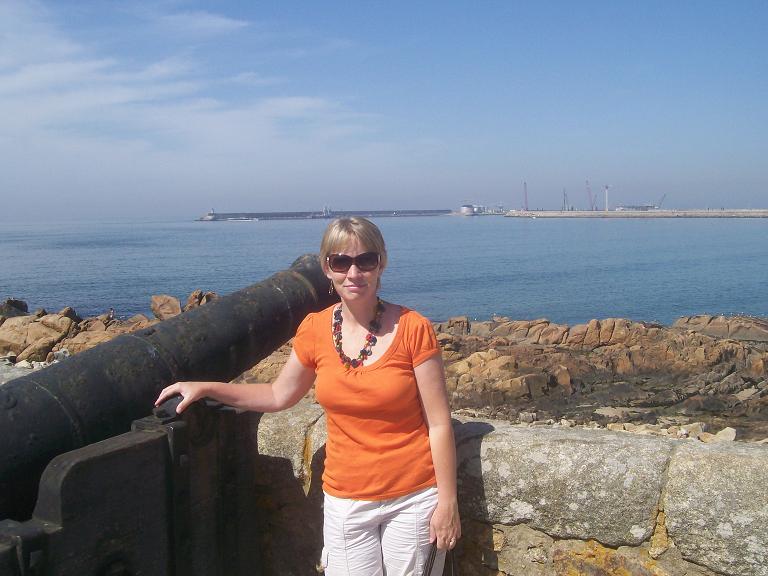
Turning around, we headed back across the Ponte de Luis I again, through downtown Porto, up past the Se Cathedral and looped back to where we started at the hotel. We then rode the first part of the route again, and went all the way out to the fort on the coast, where we hopped off the bus for the first time and took a very cheap tour of the fort, which is now a memorial for the Commandos of the Portugese military. Cheapest WC in town, by the way. After leaving the fort, we walked along the waterfront on a nice boardwalk, looking at all the bathers and folks wading in the tidepools, until we got to an area where there were a bunch of little cafes, where we stopped for a light lunch. Michele had Salada de Atum (tuna) and I had a Baguette da Delicious do Mar (seafood sandwich), which was a little light on the seafood, but wonderfully crunchy with a nice flavor. When we were done, we continued our stroll all the way down to the Foz, where we waited for a long time for the bus to come by again. I think they go to hourly service in the middle of the day rather than every thirty minutes.
 |
| At the Cheese Fort |
Stayed on the bus long enough to reach the stop for the Museu de Electrocarros, the tram museum, where we paid 7 euros to go inside and look at their very interesting collection of antique trams from the 1800s and early 20th century. There was also a small area where they obviously entertain kids, with a rather elaborate toy train setup. If we had known it, the ticket we bought at the museum would have allowed us to ride the trams in town for four hours, but we'd already planned to jump back on the bus and head to the south side of the river again, to look at all the boats down there, so we skipped the tram ride, alas.
 |
| Mule Drawn Trolley |
Monday, September 13, 2010
The Pilgrimage to Fatima
 |
| In the square at Fatima |
 |
| Manuel and John, the Baptist |
 |
| The Tomb of Henry the Navigator |
Onward from Fatima to Batalha, where the Portugese fought a decisive battle agains the Spaniards, we visited the Monastery of Santa Maria, where a number of the Portugese kings are entombed, including Henry the Navigator. There's a section of the Monastery that was intended to be a series of seven chapels, on which construction was suspended after Vasco de Gama returned from India, that remains unfinished to this day, which is quite interesting, architecturaly. There was also a huge antique sale going on in the village square near the monastery that had plenty of good old junk.
 |
| The overlook at Nazare |
Onwards from there to the Lago de Obidos, an immense tidal lagoon near the town of Obidos, where we enjoyed a beautiful sunset, and a quartet of cafes in a restaurant overlooking the water. We made a brief stop after dark to climb up the castle walls in town, before heading back south to Cascais. A great day, just needed more daylight hours to get it all done.
Sunday, September 12, 2010
Down by the Sea
 |
| On the Guincho |
 |
| Playing Rackets |
Manny taught us a new game called rackets, which basically involves hitting a ball back and forth between two or more people, that appears to be popular here. We snacked on some juice boxes - they make them in large sizes here, not just the kiddie boxes - and had some custard pastries and some little snack-y chocolate things, mini-biscuits, and swam a bit and laid out on our beach towels. Perfect relaxation.
 |
| Palm Beach and Harbor |
Came home and showered up, folded laundry, snacked on some cheese, olives, and nuts. Irene has bacalhau in the oven for dinner, and it smells delicious. Ciao!
Saturday, September 11, 2010
Lisbon, a little slower
We decided to slow down the frantic pace a bit for our second day in Lisbon. We stopped by the travel agent in Cascais in the morning and got our trip up north figured out, then went to the train station and took a short hop into Estoril, a lovely beach town nearby, to look for a music museum from the guides, and spent about an hour wandering up and down the avenues looking for it. Signage here can be, er, problematic. Gave up on the quest and went back to the train station to head into Lisbon.
 Over here, public transportation is key to getting around the area. We're still having a tough time figuring out how it all works. In fact, we never did climb on a bus or metro, just the train and that one trolley. I could never quite determine which of the trains into Lisbon actually stopped at Belem, and couldn't find a brochure with a schedule on it anywhere, though there were "schedules" posted on big signs inside the station. Same thing applied to the buses, for me. Next trip to a major metropolis, I must find schedules beforehand.
So, as a result, we hopped off the train at Alges, one stop before Belem. It was lunchtime for us at that point, so we found a nice little cafeteria downtown, reminiscent of one of the old Woolworths, and had lunch with a bunch of local shoppers and businessmen, away from the touristy area of the city. Michele had Salada com Gambas, shrimp salad, and I had Bifinas com Champignous, sliced roast pork with mushrooms and a light gravy, accompanied by rice, salad and fries. We had a little appetizer of (sp?) Queizo Frais, fresh cheese, a little like a cottage cheese in flavor but a sliceable consistency, and bread. We chatted with our waiter about the source of the french fries (London, not Idaho), and had a nice break.
Just missed the trolley that went to Belem - actually we were arguing over whether it was the right trolley or not when it went by, Michele was right, I was wrong - so we set out to follow the trolly tracks on foot. Didn't take too long to get to Belem and we found a pedestrian bridge across the street to the Torre de Belem, one of the early fortifications which kept people from coming up the river Tagus to attack Lisbon. We climbed nearly to the top of the tower, and looked out at the scenery. If you're claustrophobic, the spiral staircases there are a nightmare, with people attempting to climb up and down at the same time in a space really meant for one.
It's a pleasant walk along the shores of the river, through a park, past the marina to the next attraction, and plenty of little souvenir shops and eateries where you can grab a drink or snack. I am happy to report that there was only one boat on the boat ramp on a friday afternoon, though the husband shouting at his wife trying to back the trailer into the water was just like the scene at Lucky Peak back home. From a distance, the Padrao dos Descobrimentos doesn't look all that big, but as you slowly get closer, it assumes Rushmore-like qualities. The monument is designed in the shape of a caravello, a sailing boat, and is lined with the figures of royalty, explorers and other famed Portugese. There's an elevator ride to the top, but we weren't all that interested in waiting in line for it, for a slightly different perspective on the river views. We spoke a bit with an Iranian couple, who now live in Canada, and helped each other get photos taken.
 Manny had been helping his friend, Ricardo, deliver some cases of wine for his mother's business, early in the day, but he drove into town to join us at this point, and we went into the Mosteiro dos Jeronimos, which is a 16th century monastery, containing the National Museum of Archeology, for a brief look at the church. The place was crowded with bus after bus of tourists, and we decided we wanted to see the more modern side of Lisbon, instead of taking the full tour of the museum. Manny drove us all out to the area where the 1998 World's Fair was held, and we had a nice time at the Oceanario, looking at the marine life, including one pacific otter who is a long long way from home. We promised to say hello to his Northwest cousins when we get back. There was a great display about amphibians, with a ton of exotic frogs. I do love little froggies.
This entire area was an old deteriorating portion of the city before the Fair, but it is a wonderful example of modernity now. One of my favorites was the volcano shaped fountains that burble along merrily for about twenty minutes, then suddenly "erupt", spraying water far into the air. Couldn't catch an eruption on camera as we were driving through, unfortunately. After exploring the area by car, we headed back up the coast to Cascais, stopped at the grocery store to pick up some cheeses, sausage, olives - there are dozens of varieties to chose from here - then to a local chicken roastery - think KFC in popularity, and with a walk-through pickup window - for a couple of whole roast chickens, one buttered, the other spicy, and back to the house to gather with Manuel and Irene and Robert for a late dinner and loads of good conversation after out on the patio, with the cool ocean breeze blowing. I leave you with a peaceful image from the church of the Jeronimos.

 |
| In the Torre Belem |
 |
| Doc de Bom Successo |
 |
| Padrao de Descobrimentos |
 |
| Mosteiro across the Praca |
There's a pedestrian underpass nearby, with street vendors and one particularly bad street saxophonist to get by, and we crossed the road to arrive at the Praca do Imperio, a very nice park with a large round central fountain, reflecting ponds with the obligatory horse statues, and lots and lots of park benches with shady spots to relax, check the guidebook, and regroup. Right next to the Praca is the Centro Cultural de Belem, where they hold concerts and recitals, and which also contains a museum of modern art, Museu Berardo. We went inside, where it was A) air conditioned, and B) had very clean nice bathrooms, and spent some time looking at and failing to comprehend pretty much the entire collection. I mean, it's obvious in some undefinable way that it is Art, but it's nothing I'd want to look at in my living room or office for any length of time, so who buys this stuff, anyway? There were a couple of pieces I found more whimsical by a South African artist, but the rest of it left me cold.
 Manny had been helping his friend, Ricardo, deliver some cases of wine for his mother's business, early in the day, but he drove into town to join us at this point, and we went into the Mosteiro dos Jeronimos, which is a 16th century monastery, containing the National Museum of Archeology, for a brief look at the church. The place was crowded with bus after bus of tourists, and we decided we wanted to see the more modern side of Lisbon, instead of taking the full tour of the museum. Manny drove us all out to the area where the 1998 World's Fair was held, and we had a nice time at the Oceanario, looking at the marine life, including one pacific otter who is a long long way from home. We promised to say hello to his Northwest cousins when we get back. There was a great display about amphibians, with a ton of exotic frogs. I do love little froggies.
 |
| Interior shots never turn out this well |
Friday, September 10, 2010
Rick Steves' Portugal by Rick Steves

 My wife and I love Rick Steves' travel shows. If we happen to be surfing the tube and catch him on PBS, we stop to watch his adventures. So, when I first started thinking about a European adventure, I rushed to the library and grabbed all the stuff by him that they had.
 Like all of his travel books, this is packed with information, but not a monstrous tome that you'll wear out your arms carrying it on the trip. Also, like the rest of them, Rick Steves' Portugal has about twenty pages of introductory information that's just generally good advice for travel in any country, with the specific country information pasted in, and some very country-specific practical information in the appendix at the end of the book. The appendix contains a short history of Portugal, information on telephones, email and mail, transportation, holidays and festivals, and a short list of "survival phrases" in Portuguese.
The bulk of the book is broken into sections by area, with instructions about the best way to travel to the location, the main neighborhoods and attractions, great places to stay and to dine, and background information about the area and its sights and activities.
One of the things I really like is the way Steves' whittles down the information on, for example, lodgings in each city to three to a half dozen options, ranked by expense. Most of the places he lists are not going to be found on Orbitz or Travelocity's hotel searches, and he provides contact and reservation information for all of them. He also provides an itinerary for a walking tour in each city, as well as listing various motorized tour options and even private guides for hire.
For the moment, I'm giving this book an excellent rating, but I'll know for sure when I'm done jaunting around Portugal in a few weeks, and I'll update this post then.
Lisbon, on the Run


Enough of Lisbon for one day on our plate, though we took a number of photos of more statues along the way downhill, we headed back to the train station, went back to Cascais, and had a fantastic meal of seafood stew for two at a restaurant called Checkers. Full and happy, we went back home, and eventually, to bed.
Subscribe to:
Posts (Atom)